
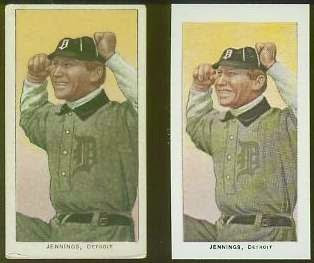
 Counterfeit baseball cards have been around for decades, but with prices for vintage material on sometimes lofty ground, it's best to understand what's real and what isn't before you make a major purchase.
A standard and often highly effective way to detect counterfeits and reprints is by directly comparing the card in question with one or more known genuine examples. Granted, it is uncommon for the collector to already own duplicates, especially if it's a 1933 Goudey Babe Ruth or 1965 Topps Joe Namath. However, good judgment is often made when comparing a card to different cards from the same issue. Comparing the Ruth to a bunch of Goudey commons and the Namath to a handful of other 1965 Topps.
A T206 Ty Cobb, and even a T206 Honus Wagner, was printed on the same sheet as T206 commons. The printers did not bring out special cardstock and VIP inks for the superstars. When you are studying the qualities of T206 commons, you are also studying the qualities of the T206 Honus Wagner and Ed Plank.
In nearly all cases, counterfeits and reprints are significantly different than the real card in one and usually more than one way. However, in many cases, even though a difference or two is identified (cardboard a bit thinner and lighter in color), this doesn't answer whether the difference is due to fakery or is a genuine variation. Other techniques described in this guide will be needed.
Comparing cards is highly effective in identifying modern counterfeits. If you know how to properly compare cards, you should be able to identify a fake 1986-7 Fleer Michael Jordan and 1979-80 OPC Wayne Gretzky.
Before examination, the collector should be aware of variations within an issue. A genuine 1956 Topps baseball cards can be found on dark grey or light grey cardboard. While the 1887 Old Judges are usually sepia in color, pink examples can be found. The examiner must also take into consideration reasonable variations due to aging and wear. A stained card may be darker than others. An extremely worn or trimmed card may be shorter and lighter in weight than others in the issue. A card that has glue on back will allow less light through when put up to the light. The collector will often have to make a judgment call when taking these variations into effect. This is why having experience with a variety of cards is important.
The following is a short list of things to look at. You are welcome to add your own things to the list.
Obvious Differences: This can include text or copyright date indicating the card is a reprint, major size difference, wrong back. Many of these problems are obvious even in an online scan.
If you are experienced with an issue, perhaps you've collected Goudeys for the last few years, most reprints and counterfeits within that issue will obvious. They simply will look bad.
Dimensions of face and back: This can do be done through comparison with numerous other cards. Price guides will list the size for standard issues.
Dimensions of printing: This includes size of the image, borders and text. Most counterfeits made by photocopiers will have correct measurements. However, a counterfeit of the 1956 Topps Willie Mays card had the correct card measurement but the print itself, including the image of Mays, was too large. This created borders around the image that were too thin.
Solid areas: With a magnifier or microscope, compare which areas are solid and which are not. On a genuine T206, the border around the player picture and the player's name and team below is solid. While many reprints will also have these areas solid, many will not.
Weight: Significant differences in card weight can be important, signifying that a different cardstock was used. Small differences are less significant and could be due to natural variation.
Appearance of card stock and surfaces: This includes color, texture, feel, etc. The correct gloss is hard to duplicate on a reprint, and most reprints will have different gloss than the original. Make sure to check both sides. A T206 and 1951 Bowman, for examples, have different textures front versus back. Make sure to check the thickness, color and appearance of the card's thickness or edge. The edge often shows the cardstock to be different.
Font and size of lettering and border lines: Some reprinters go to the effort of recreating the lettering and border lines, making them solid like with the originals. In many of these reprints, the font of the lettering is noticeably off. This includes the thinness of the lines, height of the letters, and the distance between lines of lettering. If you are familiar with an issue, the lettering on one of these reprints will be strikingly different on first glace. Similarly, the border lines and designs may be noticeably different. In a few cases, the counterfeiter left out entire words from the text.
Unnatural signs of reproduction: In some cases, thoughtless errors appear on a forgery that has been photocopied or computer scanned. If a piece of lint or dirt was on the photocopier or scanner, it may appear on the reprint. A photocopier forgery of the 1952 Bowman card of Mickey Mantle has a small white mark on his chin that doesn't appear on genuine cards.
The genuine card used for reproduction may have a crease or scrape which can literally felt on the genuine card, but is only reproduced on the reprint.
Opacity: Opacity is measured by the amount of light that shines through an item, or the 'see through' effect.
Cardstock and ink vary in opacity. Some allow much light through, some allow none, while there rest will fall somewhere in between. Most dark cardboard will let through little if any light. White stocks will usually let through more. While two cardboard samples may look identical in color, texture and thickness, they may have different opacity. This could be because they were made they were made in different plants, at a different time and/or were made from different substances.
Testing opacity is a good way to compare card stock and ink. The same cards should have the same or similar opacity.
Opacity tests should be done with more than one card from the issue. Comparisons should take into consideration variations due to age, staining, soiling and other wear, along with known card stock variations in the issue. It must be taken into consideration that normal differences in ink on the card will affect opacity. If one genuine T206 card has a darker picture (a dark uniformed player against dark background), it should let less light through than a genuine T206 card with a lighter picture (a white uniformed player against a light sky).
The opacity test can detect many restored expensive cards. In the past, some genuine but low grade star cards (1933 Goudey Ruth, T206 Cobb, etc) have been restored in part by having the rounded corners rebuilt with paper fibers from other cards and glue. When held to the light, the built up corners are often seen as they let through a different amount of light than the rest of the card.